


Why Fairy Tales Are So Good at Hiding Political Violence

Fairy tales are violent.
Children are abandoned in forests. Wolves eat grandmothers. Queens order executions. Girls are poisoned. Boys are transformed, imprisoned, mutilated or sent out to die. Entire families disappear because someone powerful has made a decision.
We rarely describe these as political stories.
Perhaps we should.
The violence of the fairy tale is often treated as elemental. There is a king because there are kings. There are poor people because there are poor people. The forest is dangerous because forests are dangerous. A decree goes out across the kingdom, and nobody asks what administrative machinery carries it from the palace to the village.
That is part of what makes the form so useful for talking about power.
Once upon a time, there was a king
Consider what those words accomplish.
A king appears, and the story does not have to justify monarchy. His authority is simply one of the facts of the world, like winter or hunger. If he orders that every spinning wheel in the kingdom be destroyed, they are destroyed. If he promises his daughter to a stranger, her consent may be irrelevant. If he sends three sons on an impossible quest, they go.
Modern political fiction usually has to explain power. Who governs? How did they obtain authority? Which institutions support them? Who opposes them?
The fairy tale can skip all of this.
The king is the king.
And that makes the fairy tale strangely good at reproducing the experience of living under power. Most people do not encounter the state as a constitutional theory. They encounter a letter, a tax, a border, a soldier, a policeman, a school rule, a permit that has been refused.
The system simply exists around them.
So does the kingdom.
Violence becomes part of the scenery
Fairy tales also perform a peculiar trick with brutality: they make the extraordinary ordinary.
A ruler wants someone killed. A child is left to die. A community excludes an outsider. A family sacrifices one member for the survival or advancement of another.
And then the story moves on.
There may be no psychological excavation of the victim. There may be no parliamentary debate, newspaper investigation or commission of inquiry. Often there is barely a funeral.
This economy is one reason fairy tales can be disturbing even when the language describing their violence is simple.
The horror is not only what happens.
It is how little explanation the world requires before allowing it to happen.
That is also a recognizable feature of political violence. From a distance, history is filled with enormous abstractions: wars, expulsions, occupations, revolutions, purges, migrations.
From inside them, there is usually a Tuesday morning.
Someone has to leave a house.
Someone's name has appeared on a list.
A road is suddenly closed.
A neighbor is no longer there.
The fairy tale understands this compression instinctively. It can reduce a catastrophe to a sentence:
And so they were driven from the kingdom.
The sentence may contain the destruction of thousands of lives. The story does not have to show them.
Neither does propaganda.
The monster is useful
Fairy tales are particularly good at deciding who deserves violence.
They give us monsters.
The witch is wicked. The giant is cruel. The wolf is hungry. The stepmother is jealous. Once the story has established this, remarkably unpleasant things can happen to them without troubling the moral structure of the tale.
The witch in Hansel and Gretel is burned alive.
We cheer.
This is not because fairy tales secretly corrupt us. It is because narrative classification is extraordinarily powerful.
First determine who the monster is.
Then almost anything done to the monster becomes permissible.
Political language frequently works the same way. Groups of human beings become infestations, invaders, traitors, parasites, criminals, savages or existential threats. Individual distinctions disappear. Biography disappears. Once the category has been established, violence can be presented not merely as acceptable but as necessary.
The fairy tale exposes the mechanism because it uses such an extreme version of it.
There is another possibility, though.
Change the point of view.
Tell the wolf's story.
Ask where the witch came from.
Give the giant a mother.
Suddenly the moral machinery begins making uncomfortable noises.
"And they lived happily ever after"
The ending may be the most political part of all.
Fairy tales are obsessed with restoration.
The rightful prince takes the throne. The impostor is exposed. The monster is killed. The marriage occurs. The kingdom rejoices.
Order has returned.
But whose order?
We rarely hear from the people who preferred the previous king. We do not learn what happens to the soldiers who fought for the defeated side. Nobody interviews the giant's children. The woods do not issue casualty figures.
The words happily ever after perform an astonishing act of narrative authority.
They tell us when history is allowed to stop.
Real societies attempt something similar. Nations create founding stories. Victories acquire clean dates. Monuments select particular dead. Schoolbooks decide which events require three chapters and which require three sentences.
Eventually a complicated past acquires the grammar of a fairy tale.
There were good people.
There were bad people.
Something terrible happened.
We prevailed.
And therefore the world became the way it was supposed to be.
The dangerous phrase: "This is just how things are"
Perhaps this is why fairy tales survive so easily across centuries and political systems.
They do not merely teach us what happened.
They teach us what kinds of things require explanation.
A talking fox requires explanation.
A king does not.
A magic bean requires explanation.
Poverty does not.
A curse requires explanation.
A war sometimes does not.
That distinction interests me more than whether fairy tales are politically progressive or conservative. They can be either. They have been used to reinforce authority and to mock it, to police social boundaries and to undermine them.
Their deeper political power lies in normalization.
Put something inside the architecture of a story often enough and eventually it stops looking like a choice.
It becomes scenery.
Turning the mechanism around
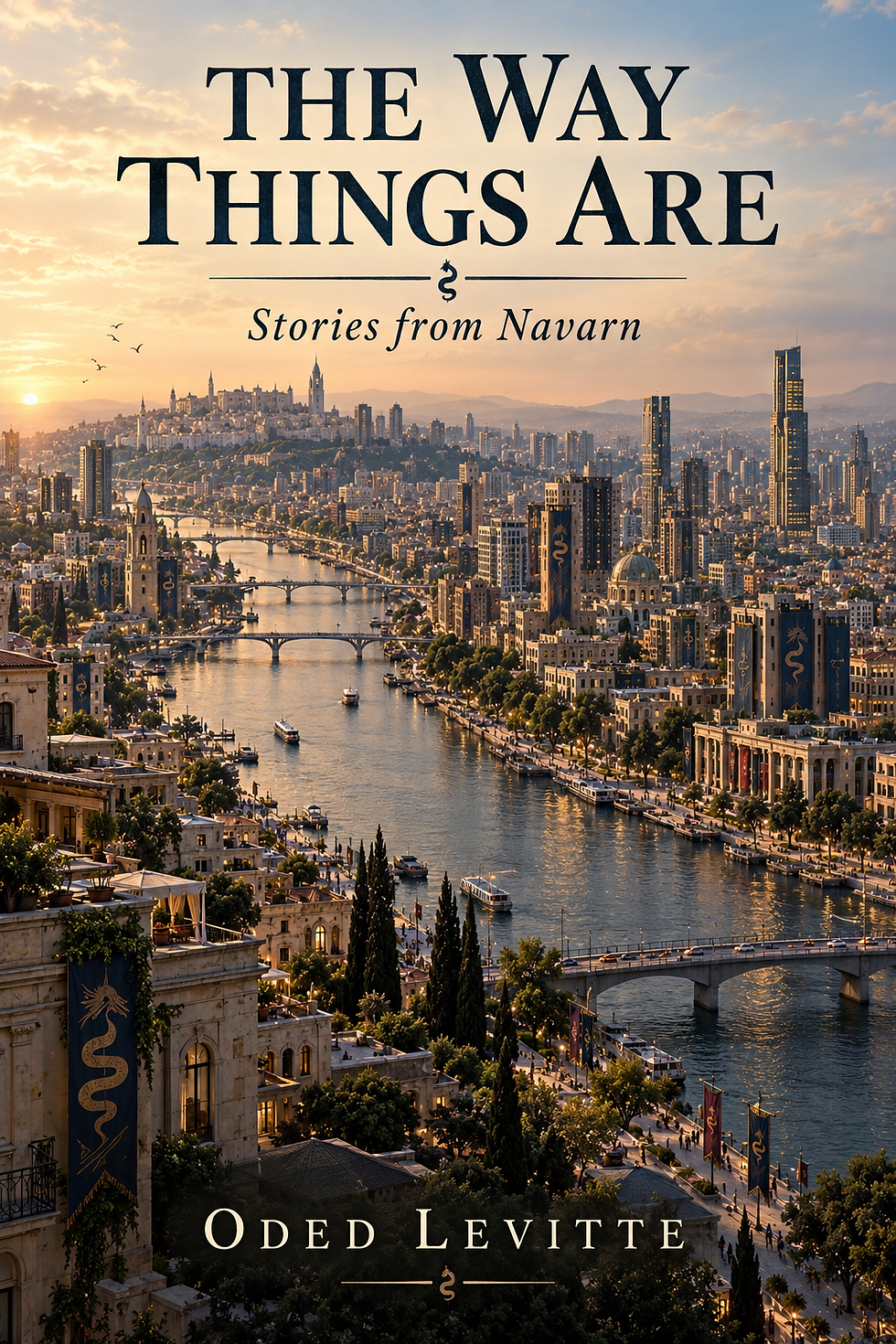
This question eventually became part of the thinking behind my own collection, The Way Things Are.
The book borrows the authority of the fairy tale deliberately: stories that seem to arrive already knowing who is good, who is dangerous, what happened and what lesson ought to be learned.
But around those stories sits another voice: the apparatus that explains, classifies and preserves them.
That apparatus has its own problems.
Because institutions can control which stories are officially told. They have much more difficulty controlling everything those stories imply.
A footnote can contradict a moral.
An explanation can reveal more than it conceals.
A story intended to demonstrate the natural order of things can accidentally make us wonder who decided that order was natural in the first place.
That, to me, is where the fairy tale becomes most interesting politically.
Not when someone replaces the wicked king with an obvious contemporary politician.
That is satire, and sometimes very good satire.
The stranger possibility is to leave the kingdom intact.
Let the king remain a king. Let the wolf remain in the forest. Let the official storyteller assure us that everything happened exactly as it should have.
Then look carefully at the edges of the story.
Who disappeared?
Who never gets to speak?
Who decided which character was the monster?
Who benefits from the happy ending?
And what had to happen before everyone could live happily ever after?
Sometimes the most political thing a story can say is not that the world is wrong.
It is simply:
This is the way things are.

Comments